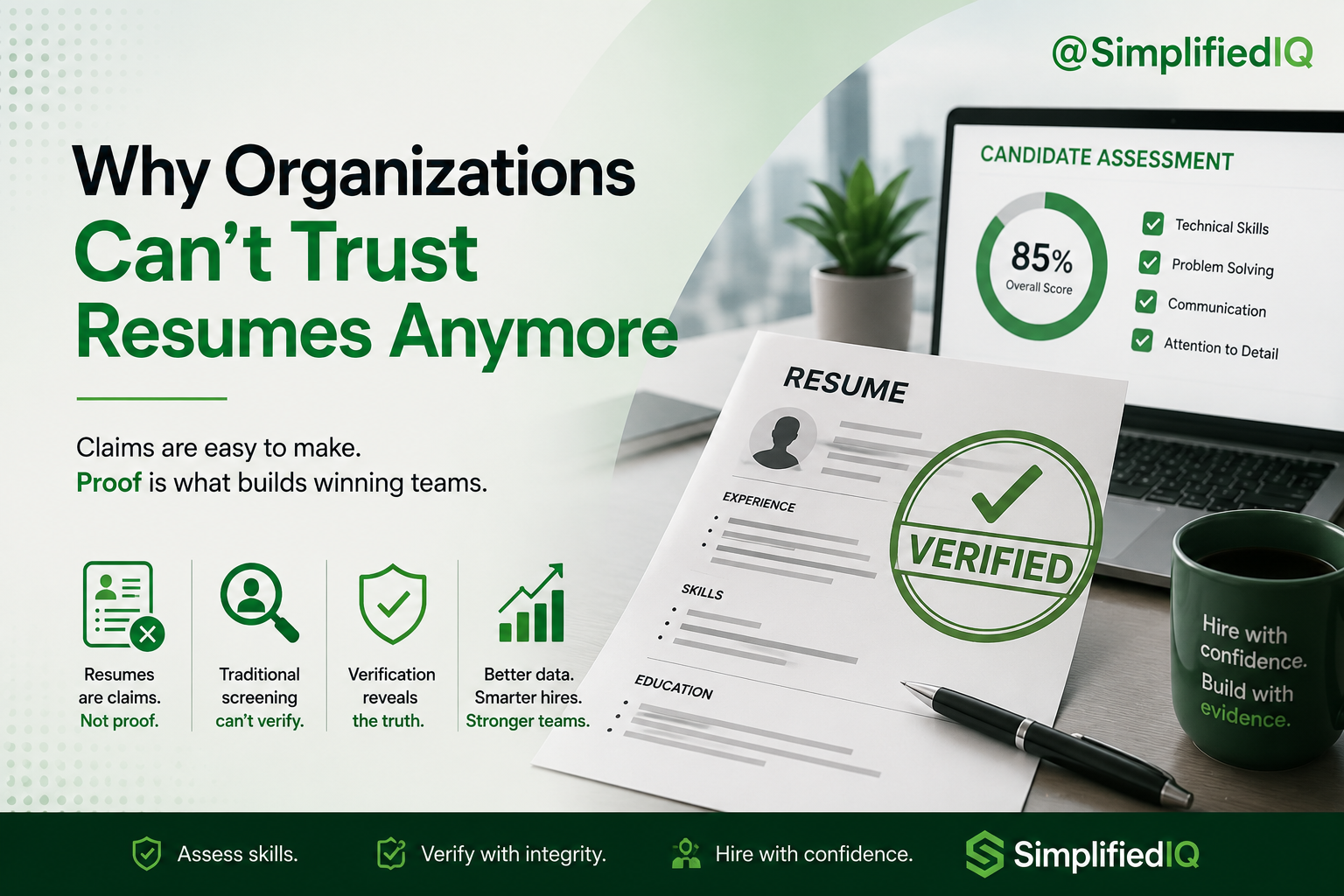
Resume verification has become one of the most important steps in modern hiring. As AI-generated resumes become more sophisticated and candidate claims become harder to validate, organizations can no longer rely on resumes alone. A resume was designed to be read—not verified. That’s exactly why resume verification has become essential for organizations that want to hire with confidence.
Every resume is built on self-reported information. Job titles, years of experience, responsibilities, certifications, and accomplishments are all claims made by the person who benefits most if they’re believed. Without resume verification, employers are left making critical hiring decisions based largely on trust.
For years, that approach worked well enough. Today, it no longer does.
The Growing Need for Resume Verification
If you’ve ever suspected a candidate exaggerated their experience, there’s a good chance your instincts were correct.
A 2026 survey of 1,500 U.S. job seekers found that 93% admitted to embellishing or misrepresenting information on their application materials. Other independent studies estimate that between 53% and 70% of professionals have lied on their resumes in some way.
The most commonly exaggerated details include:
- Job titles
- Scope of responsibilities
- Team size
- Employment dates
- Technical skills
Ironically, these are also the details hiring managers depend on most when evaluating candidates.
The rise of generative AI has made the challenge even greater. Today, candidates can produce polished, keyword-optimized resumes in minutes, making it increasingly difficult to distinguish genuine experience from carefully crafted claims.
This is exactly why resume verification has shifted from being a nice-to-have process to a business necessity.
Why Traditional Hiring Doesn’t Replace Resume Verification
Many organizations assume their existing hiring process naturally verifies candidate information.
In reality, it doesn’t.
Applicant Tracking Systems (ATS) scan resumes for keywords—not accuracy.
Recruiters typically spend 15 to 30 minutes screening candidates, focusing on communication skills and overall fit rather than verifying employment history.
Reference checks rely on contacts chosen by the candidate, making them inherently biased.
Interviews evaluate how confidently someone can discuss their experience—not whether the experience happened exactly as described.
Each stage is designed to move candidates through the hiring pipeline efficiently.
Very few stages actually perform meaningful resume verification.
That leaves organizations vulnerable to hiring decisions based on assumptions instead of evidence.
The Cost of Skipping Resume Verification
Hiring someone based on inaccurate information is expensive.
A bad hire affects far more than payroll.
Organizations absorb costs through:
- Lost productivity
- Onboarding and training expenses
- Delayed projects
- Lower team morale
- Recruitment costs to refill the role
- Management time spent correcting performance issues
Many HR studies estimate these costs reach tens of thousands of dollars for a single poor hiring decision.
Yet the greatest cost is often trust.
When hiring managers discover that candidate claims weren’t accurate, confidence in the hiring process begins to erode. Leaders demand additional approvals, more interviews, and more administrative steps—not because they’re better, but because they’re trying to compensate for missing resume verification.
The hiring process becomes slower without becoming more reliable.
Resume Verification Is the Missing Layer
When organizations recognize hiring risks, the instinct is usually to add more interviews, more paperwork, and more reference calls.
Those extra steps rarely solve the real problem.
What’s missing isn’t more process.
It’s resume verification.
Modern hiring should focus on replacing self-reported claims with measurable evidence.
Instead of asking candidates to describe their skills, employers should create opportunities for candidates to demonstrate them.
Instead of trusting every claim on a resume, organizations should rely on verified assessment results.
Instead of defending hiring decisions with instinct, hiring teams should defend them with documented evidence.
That’s exactly what effective resume verification delivers.
What Resume Verification Looks Like in Practice
Imagine two hiring scenarios.
In the first, a candidate claims advanced data analysis skills.
The resume passes the ATS.
The interview goes well.
The hiring manager makes an offer.
Three months later, the employee struggles to perform core responsibilities, creating delays and additional costs.
Now imagine the same hiring process with resume verification.
That same candidate completes a short, role-specific assessment before moving forward.
Rather than relying on resume claims, the employer receives objective evidence of the candidate’s actual ability.
The hiring decision becomes faster, more confident, and significantly less risky.
That’s the value of resume verification.
How SimplifiedIQ Supports Resume Verification
Organizations don’t need longer hiring processes.
They need smarter ones.
SimplifiedIQ helps organizations strengthen resume verification by allowing hiring teams to create trusted assessments in minutes, validate candidate skills through measurable performance, protect assessment integrity, and make evidence-based hiring decisions.
Instead of relying solely on resumes, organizations gain objective proof that candidates can perform the work they’re being hired to do.
The result is a hiring process that’s more accurate, more defensible, and better equipped for today’s workforce.
The Future of Hiring Depends on Resume Verification
As AI-generated resumes become more common and hiring risks continue to grow, resume verification will become one of the defining practices of successful organizations.
Companies that invest in resume verification won’t just reduce hiring mistakes.
They’ll build hiring processes based on evidence rather than assumptions, giving managers greater confidence in every hiring decision they make.
The Bottom Line
Resumes aren’t going away, and they don’t need to. They’re still useful as a starting point — a summary of where someone says they’ve been. The mistake is treating that summary as proof.
Trust in hiring isn’t restored by asking candidates to swear a little harder that they’re telling the truth. It’s restored by building a process where the truth is easy to demonstrate and hard to fake.
Organizations that make that shift aren’t just hiring more accurately. They’re hiring with something they can defend — to their team, to leadership, and to themselves.
Want to see what this looks like for your hiring process? [Book a walkthrough / Learn more]